Fibroid surgery looks simple from a distance. You remove the fibroids, protect the uterus, and help the patient move on. Looks fine, isn’t it? But the decision gets heavier when it becomes an actual proposition. Robotic Myomectomy vs. Open Surgery: What is best for you? Suddenly, you are thinking of bleeding, pain, fertility plans, recovery time, fear of a scar and most importantly, the prospect of it coming back.
Robotic Myomectomy enters this conversation as the newer, neater option. But that doesn’t mean that open surgery is no longer valid. The reason being the traditional way still remains part of serious gynecologic care because not every uterus, and not every fibroid, behaves neatly.
What Both Procedures Are Really Trying To Do
A myomectomy doesn’t refer to the removal of the uterus and this difference matters.
Myomectomy refers to the process of removing fibroids while keeping the uterus in place. For some women, that is about ensuring the prospect of future pregnancy, and for others, it is about physical integrity, personal preference, or simply not wanting a more conclusive surgery when another option is available.
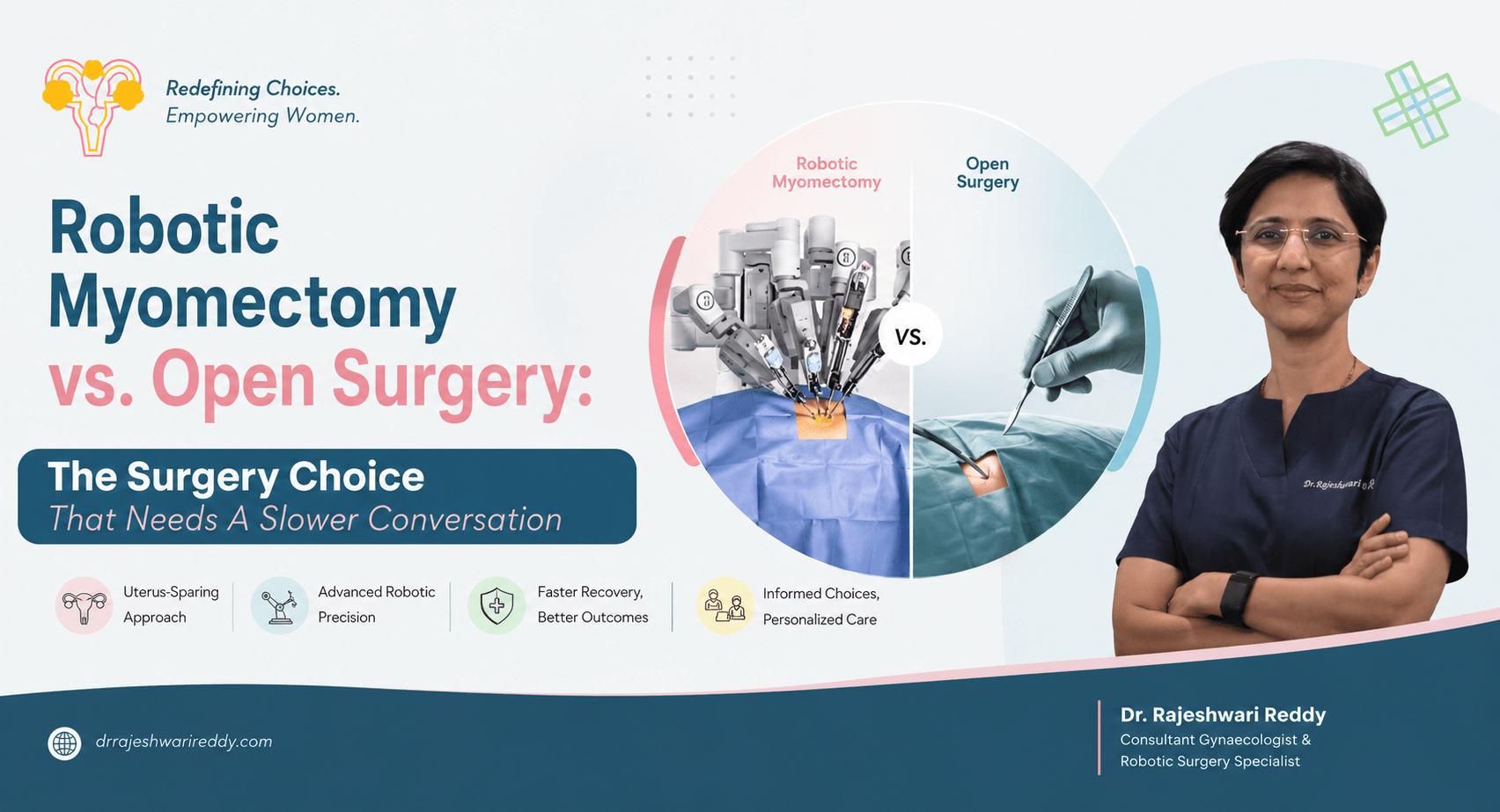
Open surgery is performed through a larger abdominal incision. The surgeon works with direct visual and manual access. On the flip side, robotic surgery works through smaller incisions, using a camera and robotic instruments controlled by the robotic surgeon and not an independent robot or some machine making decisions. Here, the surgery is still done by the surgeon, but the system only aids the doctor and improves the outcome.
Robotic Myomectomy Vs. Open Surgery At A Glance
| Factor | Robotic Myomectomy | Open Surgery |
| Incision Style | Small abdominal incisions | Larger abdominal incision |
| Surgical Access | Camera-guided, instrument-based access | Direct hand and visual access |
| Recovery Pattern | Often easier in selected cases | Usually slower and more physically demanding |
| Scarring | Smaller visible scars | More noticeable abdominal scar |
| Best Use Case | Selected fibroids with a suitable size and location | Large, multiple, or difficult fibroids |
| Main Clinical Strength | Precision and less surface trauma | Exposure, access, and control |
Why Robotic Surgery Gets So Much Attention
The appeal is not hard to understand. Smaller cuts. Less visible scarring. A recovery that may feel less punishing. People notice those things because they have to live with the recovery after everyone else has gone back to normal. For the right candidate, Robotic Myomectomy can offer a more measured way to remove fibroids without the same level of abdominal disruption often linked with open surgery.
Still, the marketing version of robotic surgery can get a little too shiny. The robot is not an achievement by itself. The surgeon’s judgment is the achievement. Robotic tools may improve visibility and allow fine movement in tight spaces, but they do not erase complexity. A difficult fibroid is still difficult. The uterus still needs careful repair after the fibroid is removed. That part is not cosmetic. It is structural.
Why Open Surgery Still Belongs In The Discussion
Open surgery can sound like the less modern choice, and that is where patients can get the wrong impression. Sometimes it is not less advanced. It is simply more appropriate. A uterus with very large fibroids, multiple fibroids, deep fibroids, or distorted anatomy may need the kind of direct access that open surgery provides. Not always. But often enough that it should not be dismissed too quickly.
The trade-off is obvious. Open surgery usually means more soreness, a larger incision, and a longer return to everyday movement. It can feel like the body has taken a bigger hit because, in a practical sense, it has. But if that larger access allows safer removal, better control of bleeding, and stronger uterine repair, then the decision becomes more serious than “small scar versus big scar.”
Questions That Actually Matter Before Surgery
- How many fibroids are there, and where are they sitting?
- Is the fibroid pattern suitable for a minimally invasive approach?
- How will the uterus be closed and reinforced after removal?
- What kind of recovery should be expected at home, not just in theory?
- Does pregnancy planning change the surgical recommendation?
Recovery Is Where The Difference Starts Feeling Personal
Recovery is never just a line in a hospital handout. It is getting out of bed without bracing the abdomen. It is walking slowly to the bathroom. It is sitting in a car and suddenly realizing the body is still angry. With Robotic Myomectomy, many patients may have a smoother recovery, but smoother does not mean effortless. Pain, fatigue, spotting, bloating, and emotional uneasiness can still show up.
Open surgery usually demands more patience. The abdominal wall needs time. Daily tasks can feel strangely big for a while. Even coughing or turning in bed can become a small project. But recovery should not be judged alone. If the fibroids are complex, the real priority may be complete removal and durable uterine repair, even if the short-term recovery is harder.
Fertility Makes The Choice More Sensitive
When the future of your pregnancy is part of the plan, then the conversation needs to slow down. A smaller incision on the skin does not automatically mean the procedure has been completed properly.
This part is not pleasant to say, but it is true. The scar on the skin will be Visible. The most important matter is the healing inside the uterus after the fibroid comes out. It will depend on where the fibroid was, how deep it sat, how many were removed, and how carefully the uterus was closed during surgery.
So, what is the right solution? Well, it depends. In some cases, Robotic Myomectomy works well for fertility-focused treatment, especially when the fibroids are easier to reach and the surgeon can repair the uterus with confidence. In other cases, open surgery gives better control. More space. More direct access. Sometimes that matters more than a smaller incision.
Final Thoughts
There is no perfect answer here for Robotic Myomectomy vs. Open Surgery. The better option is the one that fits the patient’s body, symptoms, fertility plans, medical history, and recovery capacity. Robotic Myomectomy can be a strong minimally invasive choice when precision and reduced abdominal trauma matter. Open surgery still has value when the case is more complex. The smarter decision is not rushed. It is studied, questioned, and matched to the patient in front of the surgeon.